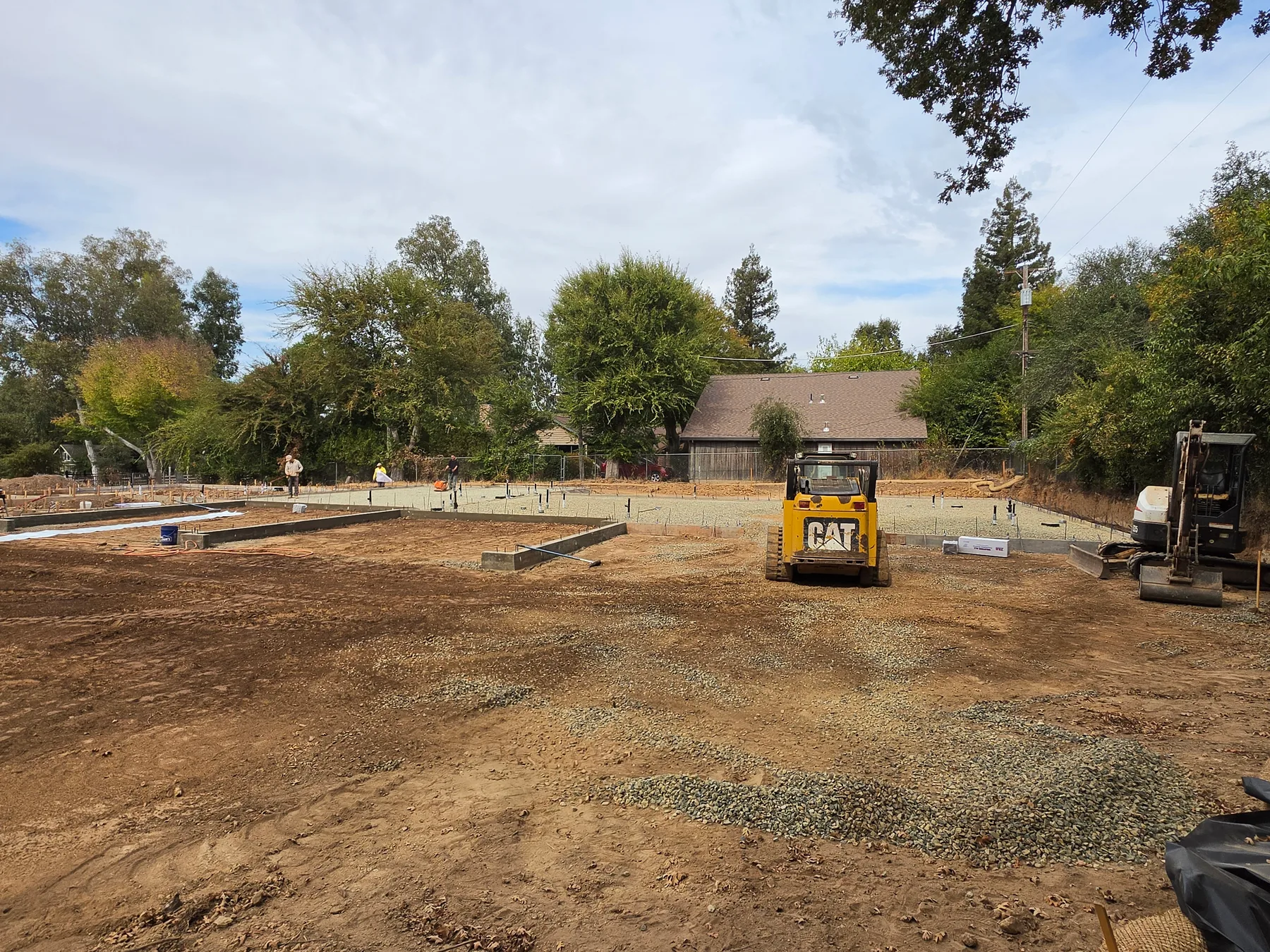
A development budget can look complete while a critical question is still unanswered: what is actually below the ground, and at what elevation? A line on an old drawing is a starting point, not the whole picture.
Before committing to a site layout, grading plan or construction sequence, it is worth asking how existing utilities interact with the proposed work. The earlier the project team understands a potential conflict, the more room there is to compare options.
Location is only half the question
Knowing that a water main crosses a site does not, on its own, establish whether it works with the proposed grades, drainage or foundations. Horizontal position and vertical elevation both matter.
FHWA describes utility information at several quality levels. Its highest level, Quality Level A, uses exposure and measurement to establish a utility's precise horizontal and vertical position at a particular point. That is different from relying only on records or a surface indication. Read FHWA's overview of subsurface utility engineering.
What potholing helps answer
Potholing is a focused investigation at selected locations. It is not an invitation to start digging yourself, and one test hole does not establish every condition along an entire utility.
A qualified utility-investigation team and the project's design professionals can decide where better information is needed, how to obtain it safely, and how to document it against the proposed design. FHWA describes this as a coordinated process involving records, detection, surveying and targeted test holes. See FHWA's explanation of the process.
How a late discovery can grow
Consider an illustrative scenario: a proposed change in site elevation conflicts with an existing public water line. The answer may involve adjusting the design, coordinating with the utility owner, or evaluating relocation. Moving a public utility is not a decision a builder makes alone.
The impact may reach beyond the pipe itself: revised drawings, approvals, access, scheduling, restoration and coordination with other work can all become questions for the team. Which of those applies, and who pays, depends on the actual project. There is no reliable universal relocation price to put on a blog post.
The lesson is to resolve the uncertainty early enough to compare alternatives. Investigation does not guarantee a conflict-free project, but it can make decisions better informed.
Five questions before the design is final
- What records do we have? Identify the utility owners and the age and limitations of the available information.
- Where are the likely conflicts? Compare the proposed building, grading, drainage and access with the known utility routes.
- Where do we need verified elevations? Have the qualified team select the investigation points and required accuracy.
- Who coordinates the decisions? Name the person responsible for communication between the owner, designer, investigator and utility provider.
- What changes if a conflict is found? Discuss design alternatives, schedule effects and budget allowances before treating an assumption as a fixed number.
Bring the question into the purchase phase
If you are considering land or a property with development potential, utility uncertainty belongs in the due-diligence conversation. Ask what can be investigated before purchase and what still needs access, specialist work or agency coordination.
Beluli Construction can help frame the construction questions and coordinate the appropriate professionals for your scope. We would rather discuss a constraint while the plan is flexible than have you discover it after the work has started.
Planning a site or a new build?
Tell us where the property is and what you are considering.
Start a project conversation →General planning information, not a site-specific engineering assessment or excavation procedure. Utility investigation and any work near existing lines should be coordinated with qualified professionals and the relevant utility owners, following current local requirements.
← Back to the journal